
- Envir-Tree
5 Signs a Tree in Your Yard May Be Too Risky to Keep
Trees often show serious warning signs before removal becomes necessary. Unlike trimming, which handles overgrowth or selected problem branches, tree removal is usually considered when the tree has major decline, structural weakness, root failure, disease, or a location-related safety risk.
A damaged or unstable tree can threaten nearby homes, vehicles, fences, walkways, and utility areas if the problem continues to worsen. Recognizing removal signs early helps property owners avoid sudden limb failure, full tree collapse, or expensive property damage.
This blog explains five clear signs that it may be time to remove a tree from the yard. Each section focuses on a specific warning sign, what it means, and why it may point to complete removal instead of routine trimming.
1. Severe Dead or Dying Sections Throughout the Tree

Extensive dead or dying sections throughout a tree can indicate that the overall health of the tree is declining. While isolated dead branches can often be removed through trimming, widespread dieback may suggest that the tree is struggling to survive.
As more sections become affected, the tree may lose its ability to grow normally and maintain structural strength. In severe cases, removal may become the safest long-term option.
How widespread decline affects tree health
Healthy trees rely on active branches and foliage to transport water and nutrients throughout the structure. When large portions of the canopy die, the tree may no longer have enough healthy growth to support itself properly.
This decline can gradually affect overall stability and increase stress on the remaining living sections. Continued deterioration often becomes more difficult to reverse over time.
Why extensive dieback may indicate irreversible damage
Severe dieback can result from disease, root problems, environmental stress, or advanced age. When a significant percentage of the tree is no longer alive, recovery becomes increasingly unlikely.
As dead sections continue to expand, the risk of falling limbs and structural failure also increases. In these situations, complete removal may provide a safer solution than repeated trimming.
2. Large Cracks, Splits, or Structural Instability
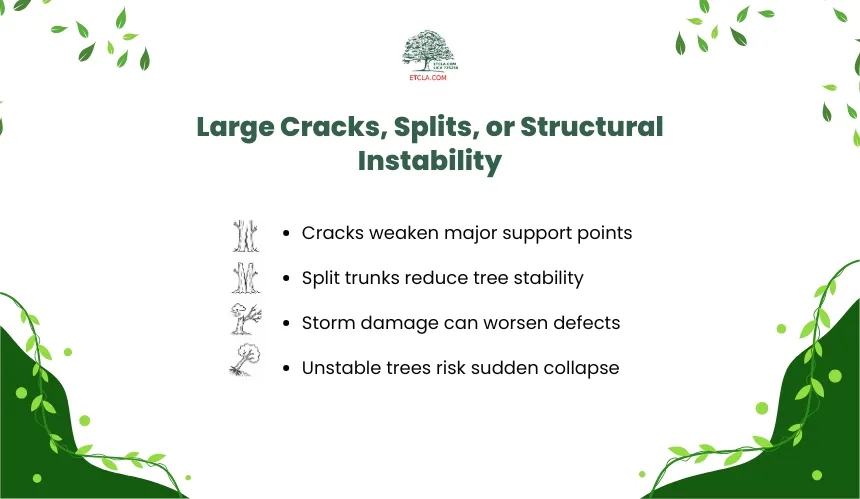
Major cracks, split trunks, and visible structural defects are strong indicators that a tree may no longer be stable. These problems weaken the tree’s ability to support its own weight and increase the risk of unexpected failure.
Structural damage may develop gradually or appear suddenly after severe weather. Regardless of the cause, significant cracks should not be ignored because they can affect the overall integrity of the tree.
Common causes of structural weakness
Trees may develop structural problems because of storm damage, heavy limbs, previous injuries, poor branch attachments, or natural aging. Repeated exposure to wind and weather can also contribute to weakening over time.
As these issues progress, cracks and splits may expand deeper into the trunk or major branches. This gradual deterioration often reduces the tree’s ability to remain stable.
Why unstable trees pose higher safety risks
A structurally compromised tree is more vulnerable to branch failure and complete collapse during strong winds or severe weather. Even under normal conditions, weakened sections may break without warning.
Because structural defects affect the tree itself rather than a few isolated branches, removal is often considered when stability can no longer be restored safely. Addressing the problem early helps reduce the risk of injury and property damage.
3. A Leaning Tree With Visible Root Problems
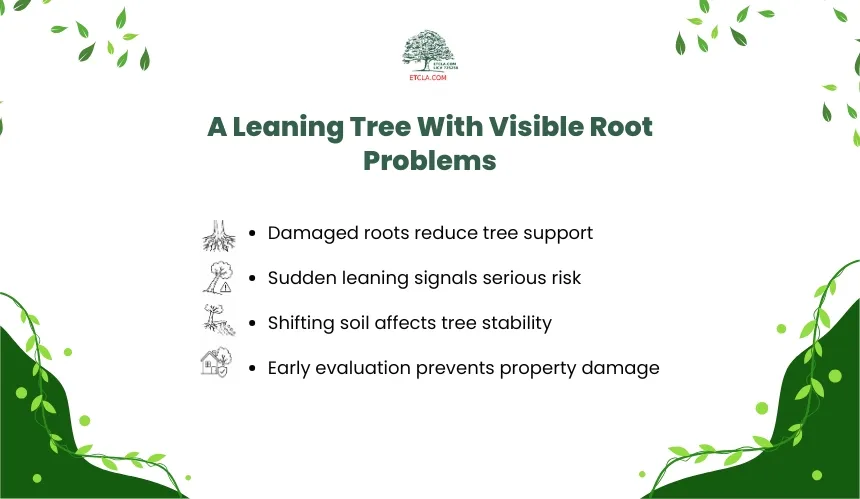
A tree that suddenly begins leaning or shows signs of root damage may be losing the support needed to remain stable. Although some trees naturally grow with a slight lean, noticeable changes in position can indicate a developing structural problem.
When root systems become compromised, the entire tree may become more vulnerable to failure. In serious cases, removal may be necessary to prevent the tree from falling unexpectedly.
How root damage affects stability
Roots anchor the tree and help supply water and nutrients throughout the structure. Damage caused by soil erosion, construction activity, disease, or decay can weaken this support system over time.
As the root system deteriorates, the tree may become less capable of supporting its own weight. This loss of stability often affects both the trunk and canopy.
Why sudden leaning should never be ignored
A sudden lean is often more concerning than a tree that has grown at an angle for many years. Changes in position may indicate root failure, shifting soil, or internal structural problems below the surface.
Because these conditions can progress quickly, a leaning tree should be evaluated before the problem worsens. Early action helps reduce the risk of complete tree failure and potential property damage.
4. Disease, Decay, or Pest Damage Affecting Major Portions of the Tree
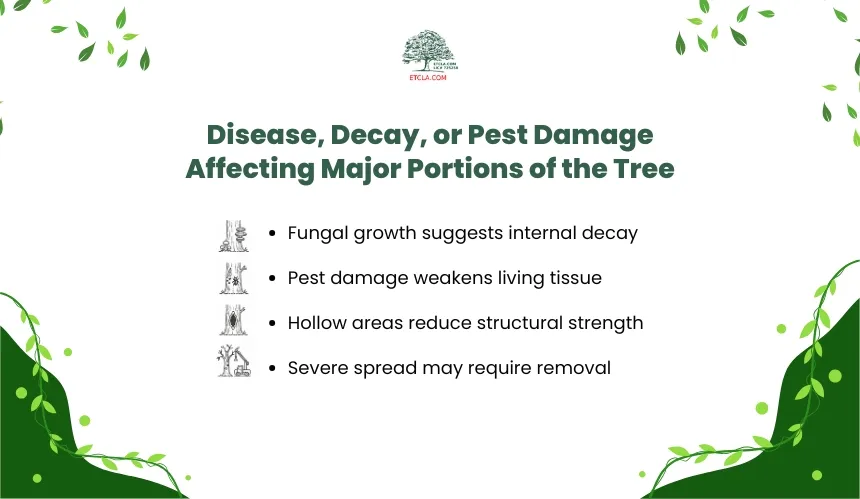
Extensive disease, internal decay, or severe pest activity can weaken a tree to the point where removal becomes necessary. While minor problems may sometimes be managed, widespread damage can affect the tree’s overall strength and long-term survival.
As these issues spread, the tree may gradually lose its ability to support healthy growth. Severe deterioration often creates both structural and safety concerns.
Signs that internal damage may be spreading
Visible symptoms may include hollow areas, fungal growth, decaying wood, peeling bark, unusual cavities, or sections of the canopy that continue to decline. Insect infestations may also leave evidence such as exit holes, sawdust-like material, or damaged bark.
These warning signs can indicate that the problem extends beyond what is visible from the outside. Internal deterioration often progresses even when portions of the tree still appear healthy.
Why severe infestations can compromise tree strength
Diseases and pests can interfere with the tree’s ability to transport nutrients and maintain structural integrity. As damage increases, branches and trunk sections may become weaker and more prone to failure.
When major portions of the tree are affected, removal may provide the safest solution. Eliminating severely damaged trees can also help prevent certain diseases or pests from spreading to nearby vegetation.
5. Tree Growth That Threatens Nearby Structures or Utilities
A tree may require removal when its location creates ongoing risks for surrounding structures, underground systems, or utility lines. In some situations, repeated trimming cannot adequately address the problem because the tree continues to grow into sensitive areas.
When space limitations become severe, removal may provide a safer and more practical long-term solution. The goal is to prevent future damage rather than repeatedly manage the same issue.
How root systems and branch growth can affect property
Expanding roots may interfere with foundations, sidewalks, driveways, underground pipes, and other nearby structures. At the same time, large branches can extend over roofs, garages, fences, and outdoor living areas.
As the tree continues growing, these problems may become increasingly difficult to manage. Repeated interference with surrounding structures often leads to ongoing maintenance concerns.
Why removal may become the safest long-term solution
Some trees outgrow their available space and continue creating conflicts despite regular maintenance. When the location itself becomes the source of the problem, trimming alone may no longer provide an effective solution.
Removing the tree can help eliminate recurring risks and prevent future damage to nearby property or utility infrastructure. In these situations, replacement with a more suitable species may offer a better long-term outcome.
Frequently Asked Questions
Can a partially dead tree still be saved?
Yes, some trees with limited dead sections may recover with proper care and pruning. However, widespread dieback affecting large portions of the canopy may indicate that removal is the safer option.
Is a leaning tree always dangerous?
Not necessarily. Some trees naturally grow at an angle, but a sudden lean or visible root disturbance can indicate instability that should be evaluated promptly.
Can tree diseases spread to nearby trees?
Certain diseases and pest infestations can spread to surrounding vegetation. Removing severely affected trees may help reduce the risk of additional damage to nearby trees.
Should a tree be removed after every storm?
No, storm damage does not automatically require removal. Some trees can recover through corrective pruning, while others may need removal if structural damage is severe.
Can large roots damage foundations and underground utilities?
Yes, aggressive root systems may interfere with sidewalks, driveways, pipes, and nearby structures. The severity depends on the tree species, location, and surrounding conditions.
Is tree removal always better than trimming?
No, many tree problems can be addressed through pruning and maintenance. Removal is generally considered when the tree has severe decline, instability, disease, or location-related hazards.